


Have you ever gone to cook with honey only to discover that every jar or container of honey you own has crystallized?
You may think you need to go buy more. However, it is possible to decrystallize honey and still use it on the same day.
Have a question about this article? Ask AI!
Jump to:
Why does honey crystallize?
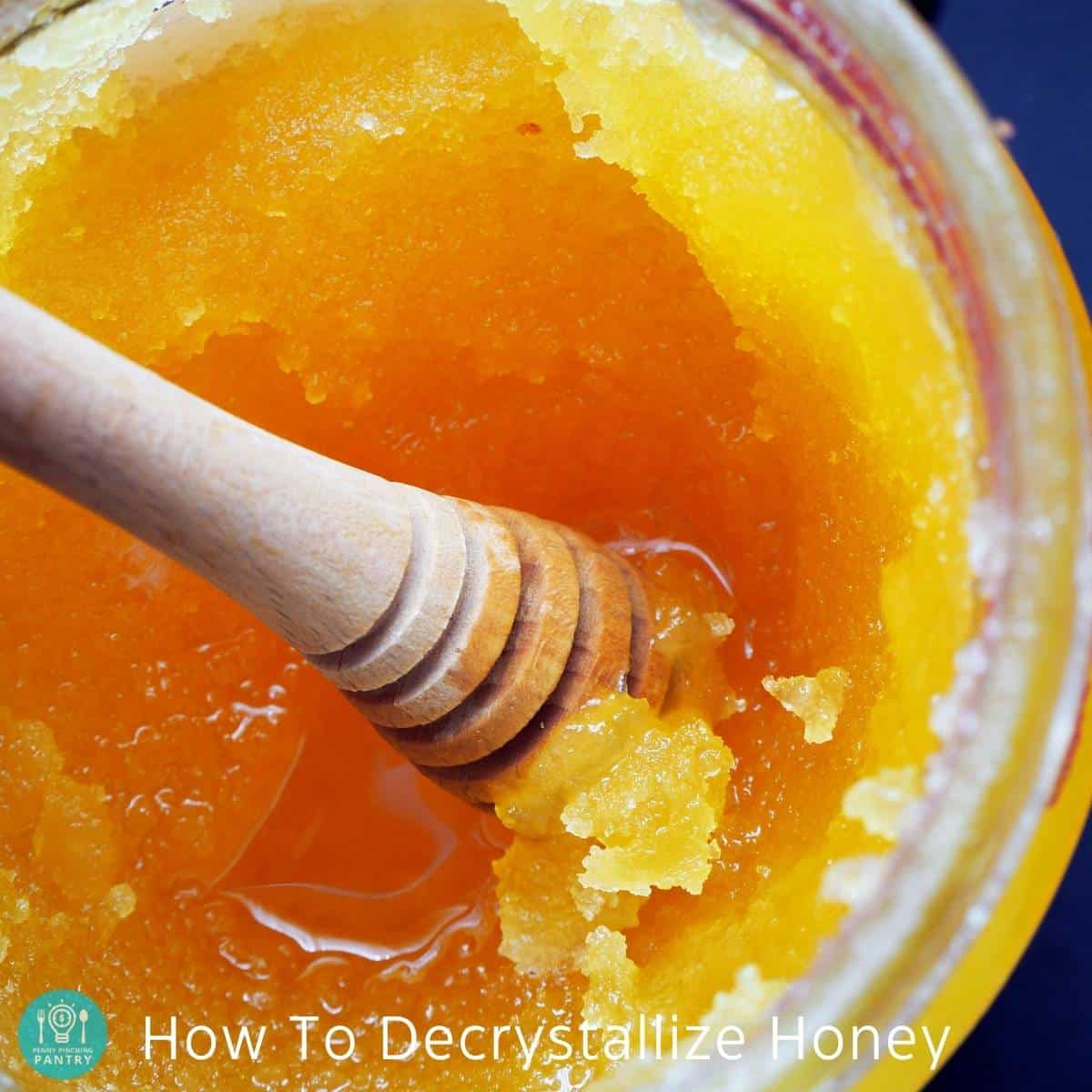
Honey crystallization happens naturally. Over time, the glucose - aka sugar molecules - in honey separates and becomes solid. This is what crystallization is. However, this is no indication as to whether or not the honey is still good.
In fact, just because you see crystallization in your honey, that doesn't mean that you have to throw it away. Honey is one of those foods with a long shelf life. As long as you closed the top of the honey jar or container properly the last time you used it, you're good to go. Top askew? Toss it in the trash.
How to decrystallize honey
To decrystallize honey is to bring it back to its liquid form. Sure, you can still bake with it when it is solid. The heat in the oven will help melt those solid sugar molecules.
However, getting accurate measurements will be a challenge. So it is in your best interest to liquify that honey so you can make a Passover honey cake or another recipe that calls for honey.
Crystallization is something that happens naturally with different grades of maple syrup, too. So, keep the following tips in mind if you find yourself wanting to cook with syrup that's become partially solid.

Honey in a glass jar versus a plastic container
There are two ways to liquify honey: using the microwave or using a warm-water bath. It all depends on what kind of vessel your honey is in. Is it a glass jar? Or do you have honey in a plastic, squeezable container? Choose the method that makes the most sense for the container.
Microwave method
When Zuzana Paar of Best Clean Eating needs to decrystallize honey in a glass jar, she uses the microwave. "I just warm it up in the microwave for a few seconds, like four or five seconds," she explained. "Then, I mix it and see if it needs a tiny bit more time in the microwave. I always try the fewest seconds possible."
This idea of microwaving for the least amount of time is a good one. Too much time in the microwave can affect honey's natural antibacterial and other positive properties, according to a study published in the National Institutes of Health National Library of Medicine.

Warm-water bath
The other proven method of how to decrystallize honey is a warm-water bath. You'll want to go this route if you're using a plastic bottle of honey, since plastic can melt in the microwave. It also works with glass jars as Erin Dooner of Texanerin Baking discovered.
"My husband is something of a honey connoisseur, so we generally have 15 to 20 types of raw honey open. Almost all of them have crystallized," she said. "To make it runny again, I place the jar in a bowl of warm water, around 100 to 110 degrees F, making sure the water doesn't get into the jar, and let it sit for about 20 minutes. With this method, the honey stays raw, maintaining its healthful benefits. This works with both glass jars and plastic bottles."
Seal it right! Always ensure your honey jar's lid is tightly closed to keep it safe. An open or loose lid could indicate it's time to discard the honey for safety.
Steps to liquefy and decrystallize honey
Using Dooner's description as a jumping-off point, here are the steps you can take to turn crystallized honey back into liquid form. All you need is a saucepan with water, a wooden spoon, and a pair of tongs. If you'd like to get an exact temperature like she did, you can use a meat thermometer.
First, place the plastic bottle of honey you want to decrystallize in your saucepan. It doesn't matter if you're using stainless steel or non-stick pans. Both will work.
Do this step before heating the water. You're putting the bottle in there to eyeball how much water you need in the pan to cover it so the water can do its magic. Now, fill the pan with water and remove the honey container.
Second, place the pan on your cooktop and bring it almost to a boil. Then, turn the heat off so it can cool slightly. If your kitchen has an electric cooktop that tends to retain its heat, move the pot to a cooler spot.
Once your honey is decrystallized, here are some great recipes you can make!
- Make this incredible Baked Brie with Honey for a warm and gooey appetizer! With just a few simple ingredients, this recipe is as delicious as it is easy to prepare.
- Honey Roasted Peanuts feature a unique blend of sweet and spicy flavors with an addictive crunch! Thanks to chipotle spice, these oven roasted peanuts have the perfect kick of heat balanced by tasty honey.
- Sticky sweet and savory, Slow Cooker Honey Garlic Ribs are perfectly tender and absolute irresistible. The meat is infused with bold flavors thanks to soy sauce, garlic, and honey.
- This Slow Cooker Honey Soy Chicken recipe will give you a taste of magical, effortless cooking. Throw the ingredients into the slow cooker, then set and forget!
- These One Pan Honey Garlic Chicken Thighs combine sweet and savory ingredients for the perfect symphony of flavors. With tender chicken and high quality results, this elegant dish is easy to make in the comfort of your own kitchen.
- You'll love this easy Crock Pot Chicken Thighs in Honey Beer Sauce recipe for a flavorful chicken dinner for your family! The chicken is cooked slowly and is perfectly seasoned in the slow cooker.
Stirring midway through decrystallization
Third, place the bottle of honey, with the top securely closed, into the water. Stir the warm water around it with a wooden spoon. If your honey is in a dark or opaque jar, you may want to remove the top now - ensuring no water gets inside - and use a small spoon to stir the honey inside the jar.
This is the method that Erin Dooner uses. "I stir the honey occasionally to distribute the warmth evenly," she explained. "Otherwise, the honey in the middle of the jar remains crystallized."
Look for color and consistency changes
If your honey is in a clear, squeezable container, you'll be able to see when the honey has started to change from crystal to liquid form. This usually happens about five minutes after taking the water off of the heat source. The honey will have gone from cloudy to clear.
At this point, use your tongs to remove the bottle from the warm-water bath. If you notice that part of the bottle is still cloudy with crystals, place it back in the water. Let it sit for another few minutes.
Once the honey has a consistent color and looks clear, it is likely fully liquified. Squeeze some out of the plastic container to test. Are you happy with the results? Now it's time to cook with honey.
Kristin's Kitchen Tip
Store honey smart! Minimize crystallization by storing honey in a warm, dry place (70-80°F) away from sunlight. A pantry near your stove or a warm cupboard helps keep it liquid longer.
Final thoughts
To reiterate, if you go to use honey that you purchased at the supermarket or a farmers market, and it has crystallized, it is still good to use. Honey stored in sealed containers can remain stable for decades, so says the National Honey Board. So, follow these steps to decrystallize the honey so you can use it repeatedly.
This article originally appeared on Bagels and Lasagna.
Thanks so much for reading! I also invite you to follow me on FACEBOOK, PINTEREST, or INSTAGRAM to keep up with what's going on in my kitchen.
And you might want to check out my Dizzy Busy and Hungry store on Amazon for a whole bunch of great kitchen products I love!
Happy saving!


Comments
No Comments